
How it Impacts Indigenous Peoples
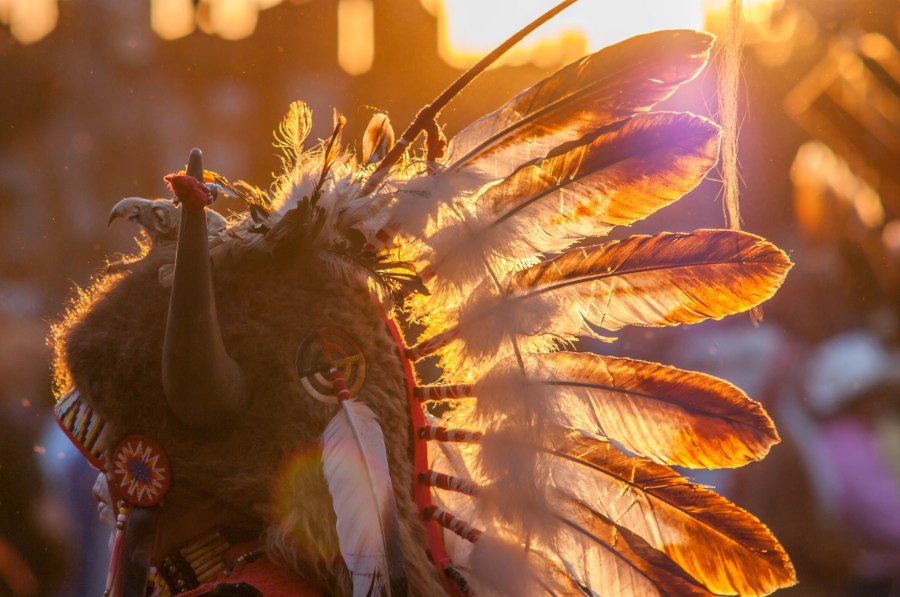
Traditional Headdress of a dancer.
The conjuncture of capitalism and neoliberalism has come to affect everybody differently. The neoliberal shrinking of government for austerity and privatization, the deregulation of business practices, and the forcing open of international markets for trade has meant greater profits and power for the owning class and market fundamentalists. For the middle and working class it has meant that corporations, not governments, are the primary decision makers when it comes to policy making and promoting values, with the result being the loss of many important social services such as health care, education, and water services. To the underclass, neoliberal antics have diminished the much-needed social welfare and social housing programs that were heavily relied upon and shifted the responsibility to individuals, their families, and local communities (Martin, 2007, p 22-23). Couple neoliberal ideology – the rejection of the welfare state and its replacement with free-market practices and doctrines – with the aggressive profiteering tactics of capitalism and its nature to harbor an “I” vs. “we” culture, and one could argue that the world, especially those under the influence of western politics, are headed toward a dystopia of wealth inequality. Although everyone from the middle-class on down will find hardship under such economic systems, there is no group more affected than the Indigenous peoples that find themselves subjected into these systems that directly conflicts with their values, separates them from their land, and forces them to into positions that perpetuate their social standing. This essay will expose the ways in which both neoliberalism and capitalism have conjoined to exploit the lands, labour, and culture of the Indigenous peoples, create physical bodily harm and harmful stereotypes, and how the existence of these systems is incompatible with Indigenous human rights.
In many ways, capitalism is a structure in which the most unfavorable characteristics of humankind – materialism, greed, selfishness, individualism – are not only encouraged but rewarded. Social value is not determined by one’s character or deeds, but by one’s market value. Those with high-status occupations or have acquired wealth are perceived as superior to those with little wealth or plebian jobs. Many people have little to no value at all because they are either not participating in the market or are located on the periphery such as the disabled, seniors, or the unemployed (Naiman, 2012, p. 130). As for Indigenous peoples, they occupy a similar position when falling into one of the mentioned categories, however, they simultaneously occupy a different position of being the original landowners of the lands that capitalist corporations have expropriated. Land once used for hunting and agriculture becomes transformed into capital and goods to be exported and sold on the free market. Indigenous people are expelled from their lands, losing access to their subsistence resources, and forced into the position of the proletariat, thus reconstructing the framework upon which Indigenous communities are built. New groups of elites and second-class citizens are built within the communities further dividing the group while accelerating the process of capitalist integration (Simon, 2011, p. 6), following the old adage of “divide and conquer”.
The capitalist necessity to accumulate and continually increase abstract wealth has led to the ever-expanding commodification process. However, a commodity may not only refer to a physical resource or object. The definition of a commodity can be housed in a more abstract realm such as spaces, symbols, time, and memories; it is in this way that the commodification of Indigeneity is able to exist. Furniss (1999) uses what she calls the “frontier myth” to describe how Indigenous history can be bought and sold for profit. She describes the myth as a historical framework that constructs a narrative of “conquest through benevolence” (p. 23). In essence, the myth is an epistemology consisting of a collection of narratives, metaphors, symbols, and themes that manifested within the context of Canadian colonization. It is used to define the relationship between Indigenous peoples and the colonial-settler population by constructing understandings of the past and present, implicitly asserting the legitimacy and morality of colonial expansion. The myth describes Canada as an empty wilderness that white Europeans battle to tame. The territory is unoccupied and untouched, thus free to claim, and in which Indigenous peoples scarcely inhabit as “noble savages” (p. 58). Indigenous peoples are framed as possessing a childishness, a “savage primitiveness” (p. 69) that requires the colonial-settlers to benevolently take on a paternalistic role to save the Natives from themselves. Out of this myth comes many popular historical literature books, especially from small publishing houses and self-published authors, which are sold in stores across British Columbia to the Euro-settler market. The histories written in these books portray Indigenous culture as the main antagonist: backward and un-progressive, while the protagonists (Euro-settlers) are painted as the saviors, bringing progress and civilization – something that the Indigenes should be thankful for. In this way, Indigenous history is manipulated, packaged and sold to both tourists and residents alike within the growing industry of heritage tourism (p. 71-72).
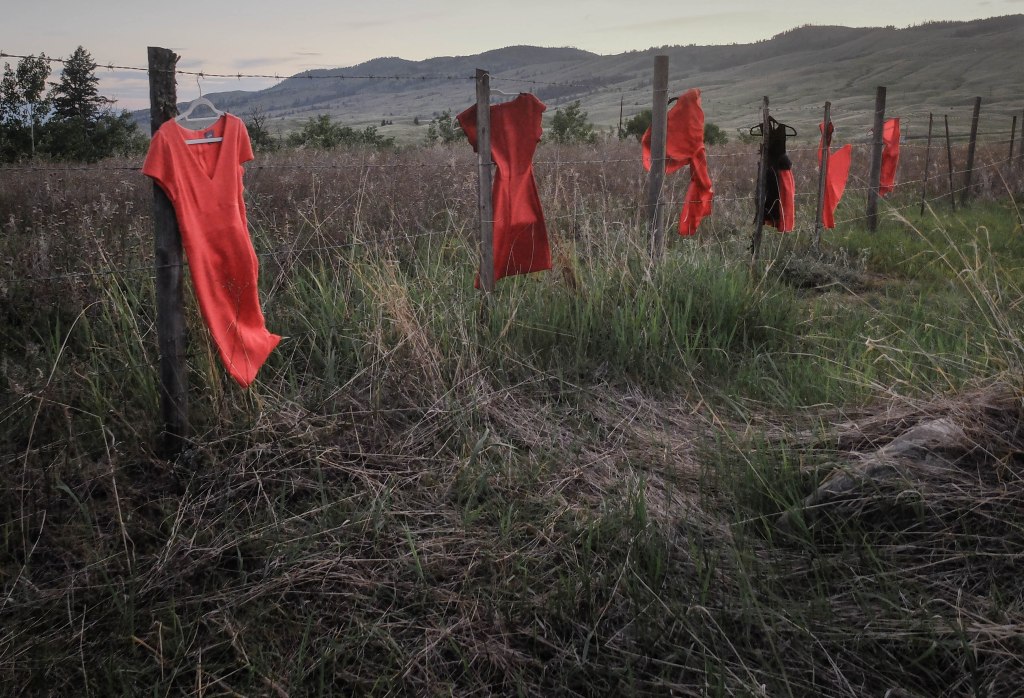
Red dresses hung on a fence
Commodification of Indigenous culture is also seen through the use of symbols which are stolen and then resold for profit, with the most blatant being the Inukshuk. Traditionally, the Inukshuk was used in a variety of ways by the Inuit, including to mark were there were preferred hunting grounds, to give direction in a vast open landscape, and to show that people have previously visited the site. They are a sign of hope and goodwill to other travelers (Steckley, 2009, p. 143). According to a former Nunavut commissioner Peter Irniq, the figures “should not be taken lightly … what we think about the Inukshuk is what we think about the Canadian flag. It’s that important” (Steckley, 2009, p. 143). Irniq goes on to point out that the term given to the Inukshuk is even incorrect: “I have seen Inukshuk built more recently – 100 years maybe by non-Inuit in Nunavut – with head, legs and arms. These are not called Inukshuk. These are called ‘inunguat’ [meaning] imitation of man” (Steckley, 2009, p. 143). Regardless of incorrect usage of the term, in 2010 the Inukshuk became the official logo for the Winter Olympics, used to endorse Canada to the world, however, without the consent from the Nunavut elders (Steckley, 2009, p. 143). Since then, the Inukshuk can be found adorning a range of objects for promotion: from stamps and coins to clothing and souvenirs. The design has been stolen, misnamed with a newly attached meaning, and sold to immigrants and other nations as a symbol of Canada’s diversity and tolerance. This fact happens to be quite ironic since the symbol was stolen from a culture that Canada is continuing to oppress, yet it is now being used to promote its multicultural acceptance.
The accompanying values surrounding capitalism of wealth accumulation has also come to negatively affect Indigenous people. When comparing the traditional nomadic Indigenous mode of production to that of capitalism, one can clearly see that both are not compatible with each other. A nomadic lifestyle requires one to limit the number of things they own – it’s a society where the only goods a person can own are what he or she may carry. The excessive accumulation of goods in this case becomes detrimental to one’s survival. Kulchyski (2005) writes “of the hunter it is truly said that his wealth is a burden. In his condition of life, goods can become grievously oppressive” (p.47). In the Indigenous social context, wealth must be viewed with suspicion, not with a desire for accumulation, and as such, poverty is social status born of capitalism (p.47). This line of thought goes against the prominent public discourse set forth by the rule laid out by capitalism which states that to be a responsible, mature, and dependable person, one must practice financial fitness: the skills, knowledge, and tools that help you make sound financial decisions. This means that a person must invest their money into an abstract market economy, with anything otherwise being considered negligent and reckless. The fact that Indigenous cultures place very little value on wealth accumulation explains why many Indigenous people have no desire to participate in aggressive cutthroat capitalism. Their disinterest in wealth gets translated to racist stereotypes such as the “lazy”, “irresponsible”, and “immoral Indian” (Furniss, 1999, p. 112). Through these stereotypes, Euro-settler Canadians express an adherence to an ideal set of neoliberal values such as materialism, capitalist work ethic, self-sufficiency, and personal responsibility, taking for granted the superiority of capitalism. These values are encapsulated within the ideal of the “self-made man”. In Canadian society, all individuals are believed to have equal opportunity for advancement; those with ample ambition and determination will prosper. This ideal can be referred to as “coloniality” which are “long-standing patterns of power that emerged as a result of colonialism, but that define culture, labour, intersubjective relations, and knowledge production” (Maldonado-Torres, 2007, ). This definition is fully realized within the manipulated Canadian histories that celebrate the individualistic heroism of the colonizer. Coloniality explains the collective impoverishment, disempowerment, and marginalization of Indigenous peoples, effectively placing the blame on them as a result of their own concerted failure to observe the exceptionality of the capitalist system and to embrace the goals, beliefs, and values needed to succeed in said system (Furniss, 1999, p. 189).
Not only is capitalism to blame for the creation of harmful stereotypes, the separation of Indigenous people from their land, and the commodification of their history and culture, but it is also directly linked to the physical bodily harm and incarceration of Indigenous people as well. To find evidence of such, one merely has to look at how indigenous peoples are treated by the RCMP and the related incarceration rates. The RCMP exist for the protection of private property: a capitalist notion. Therefore, when Indigenous groups protest against capitalist encroachment they are continually under threat of violence from the federal government. Take the Gustafson Lake standoff in 1995 for example. When Indigenous people in the area protested against how unceded Native land was being exploited by cattle ranchers for profit, the RCMP responded with “aggressive military tactics” (Belanger, 2004, p. 254). What ensued was an extensive standoff with a plethora of injuries and more incarcerations. The Gustafson Lake incident was not an exception. There are are many more incidents across Canada of the same ilk: the Burnt Church standoff, The Oka crisis, and the Oldman River Dam standoff. What all these incidents share is the injury an incarceration of Indigenous people who felt their rights were being breached through the expansion of capitalism. Belanger (2004) also notes that the increasing rate of Indigenous incarceration is linked to the need for them to move to urban areas to find work because of the overwhelming neccesity to take part in the capitalist system. Due to the previously mentioned stereotypes, racism, and lack of credentials, Indigenous people find it difficult to find meaningful work resulting in high unemployment rates. High incarceration rates can be directly related to the high unemployment rates which creates desperate people who are more likely to cause crimes. Belanger goes on to state that although First Nations peoples only make up 3% of Canada’s population, they represent 17% of those incarcerated. He also declares that Indigenous offenders are twice as likely to incarcerated as non-Native offenders, more likely to be denied bail, and more likely to be charged with crimes against the system (p. 256).
Both neoliberalism and capitalism have become so pervasive that they are seldom recognized. Society has become so deeply entrenched with the accompanying values that they have become similar to a natural law, much like gravity or evolution: It’s just the way it is. Competition has become the defining characteristic, redefining citizens as consumers, whose democratic choices are best exercised through buying and selling. People are caught in a process that rewards merit and punishes inefficiency, maintaining that the economic market delivers benefits that could never be achieved by any other system. For the Indigenous peoples located within Canada, neoliberalism and capitalism have been a curse. Capitalist values that were historically destructive to Indigenous peoples have now been amplified in the age of neoliberalism and have created a form of hyper-capitalism. Indigenous history and culture have both been commodified, attached to products, and sold for profit. A system of competition has been enforced amongst individuals that not only conflicts with the Indigenous ways of life, but is detrimental. It has produced harmful stereotypes, untrue histories, and a public discourse that maintains Indigenous subordination and ensures assimilation. And finally, capitalism has harmed Indigenous people in the most intimate way possible: through physical harm and incarceration. If Canada is to move forward in terms of human rights, to maintain it’s reputation as an all-inclusive, compassionate and tolerant society, the deeply entrenched neoliberal values will have to be addressed and remedied for they exclusively cater to the elite, not the majority of Canadians, and especially not Canada’s original inhabitants.
References
Belanger, Yale D. (2014). Ways of Knowing: An Introduction to Native Studies in Canada. Lethbridge, Alberta. Nelson Education.
Furniss, E. (2000). The Burden of History: colonialism and the frontier myth in a rural Canadian community. UBC Press.
Kulchyski, Peter. (2005). Like the Sound of a Drum: Aboriginal Cultural Politics in Denendeh and Nunavut. Winnipeg, Manitoba. University of Manitoba Press.
Maldonado-Torres, Nelson. (2007). ON THE COLONIALITY OF BEING, Cultural Studies, 21:2-3, 240-270, DOI: 10.1080/09502380601162548
Naiman, Joanne. (2012). How Societies Work: Class, Power, and Change. Halifax and Winnipeg. Fernwood Publishing.
Simon, Scott. (2011). New Proposals: Journal of Marxism and Interdisciplinary Inquiry. Vol. 5, No 1. p. 6-9.
Steckley, John L. (2009). White Lies About the Inuit. Toronto, Ontario. University of Toronto Press.
 globalindigenousvoice.org